
Why are circuit boards green?
Inside almost every electronic device — from your computer’s motherboard to a remote control — seems to have a green circuit board inside. So why that color?
Not easy being green
Printed circuit boards, or PCBs, are found in practically everything that you interact with daily that uses electricity. Everything from computers and cell phones to cars and trucks, your household appliances and remote controls, they all have PCBs in them somewhere.
Though some are red, blue, yellow, black, white, or brown — but why, for the most part, are the vast majority of circuit boards green?
A bit of anatomy
A PCB is made of many layers of different materials. Without going into excruciating detail, circuit boards are essentially comprised of four different bits:
Conducting layers — made of thin copper foil
Insulating layers — Teflon is a common one
Epoxy resin (impregnated with fiberglass or similar) — to bind the conducting and insulating layers together
Solder mask — the bit that coats the board and covers the traces
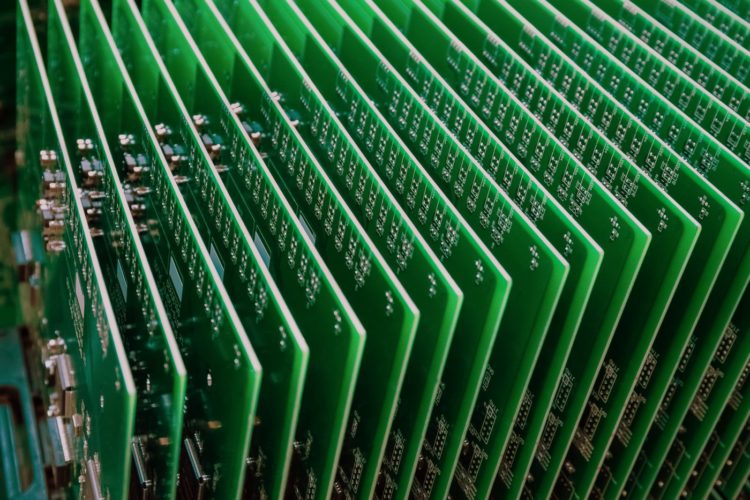
It’s the solder mask that gives the board its distinctive (typically) green color. It is also the layer that the silkscreened notations are printed on, so you know where everything is supposed to go.
It’s not envy
After searching high and low for this one, there didn’t seem to be one conclusive answer as to why green is the preferred color.
One story has it, according to an actual PCB manufacturer, that the original masks used a base resin that was a brownish-yellow color, then added a brown hardener that created a sort of ugly honey brown-looking board.
Adding red made it a “rusty adobe” color, and adding blue just made it a darker brown. However, adding more yellow to the mix ended up making a more aesthetically-pleasing green color.
Personally, having seen boards of every color — including the not-so-pleasant brown mentioned above — I think there’s probably something to that story.
Most likely today it’s a matter of tradition and cost — PCBs have been perceived as green for so long, it’s hard to move away from that — and unnecessary. As a result of it being the most popular color, the green solder mask is most likely the least expensive color to apply.