« « How much have US postage stamp prices changed? | Why do bathroom signs use circle and triangle shapes? » »
Answer
Related questions & answers:
• How much water do I need to drink in a day?• Is the city of Venice really sinking?
• What is that river by the Phoenix airport?
• Should you de-claw a cat?
Leave an answer
You must be logged in to post a comment.
« « How much have US postage stamp prices changed? | Why do bathroom signs use circle and triangle shapes? » »

This answer was chosen as best by the post author
How not to be a statistic
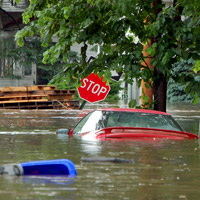
According to the US Federal Emergency Management Agency (FEMA), it doesn’t take a lot of water to potentially create a dangerous situation for you and your vehicle.
Just get out
Gordon Giesbrecht PhD, from the University of Manitoba in Winnipeg, Canada, conducted several experiments on automobile submersion and lessons in vehicle escape. His study, published in the August 2010 issue of the scientific journal Aviation, Space and Environmental Medicine, concluded that a vehicle is most easily exited during the initial floating phase — which typically lasts anywhere from 15 seconds to just over a minute — before the water level reached the bottom of the side windows.
As a guideline: Expect that you have 30 to 60 seconds to escape. So with the knowledge that your vehicle will probably float for a short time, you should have time to get out before it starts sinking.
Assuming the vehicle hasn’t been severely damaged in the accident that led to its watery predicament, you should have at least a few seconds of battery power left — maybe much more. This means that you should still be able to create some potential escape routes by rolling down windows, unlocking doors, opening the sunroof, etc. Then unfasten your seat belt and try to get out as quickly as possible through a window.
Four steps to remember
Giesbrecht and his research partner, Gerren K McDonald, suggested the following easy-to-remember four-step escape procedure:
Removing your seatbelt
There is some contention about when it’s the best time to remove your seatbelt. From the studies we found specifically relating to automobiles — not helicopters, planes or military vehicles — the advice is to pop your seatbelt and get out as quickly as possible. In fact, releasing your seat belt should be a key point you remember: many victims have been found still strapped into their cars, even when they had a means to escape. The thought is that panic and disorientation lead some people to forget to unlatch their belts.Detective Robert A May of the Indiana State Police Underwater Search and Recovery Team writes, “Advocates of staying belted while clearing the glass are putting lives in danger unnecessarily. These advocates are concerned that deepening water will toss the occupants around the cabin resulting in injury, panic, and confusion. The reality is that if the vehicle is still floating high in the water, the water will not flow over the window opening as the occupants exit. If the opening is below the water line, the water coming in will not be all that forceful. It is not like a tidal wave.”
And don’t forget about the chill factor. May adds, “An added problem is that the water may be quite cold. Occupants strapped in will be forced to remain relatively stationary in the rising water and lose body heat quickly as the interior fills. Chances are good that panic is setting in. It is better to release the seatbelt immediately and let the survival instinct work to allow a self-rescue through the window.” (Read more of May’s report here.)
Break your way out
If your vehicle is sinking quickly and you didn’t have a chance to open a door or a window, you still have options.
Try breaking a window to get out — but understand that because all vehicles are fitted with strong safety glass, they won’t break easily. The only devices proven to be effective are spring-loaded window punches or emergency window hammers — and in order for these to be useful at all, they need to be mounted somewhere that you can easily reach from your seat. (You don’t want to have to look around for it in your glove box or elsewhere in the heat of the moment. I keep mine in the car’s center console, so it can be easily reached from the front or back seats.)
Here are four emergency hammer options, as pictured above:
These all also feature seatbelt cutting tools in case your belt is jammed.
Keys, shoes, and even regular claw hammers don’t have nearly as good a chance of getting the job done. Focus your escape efforts on the side windows — particularly the upper corners — and not the windshield, which is laminated and very difficult to break open wide enough for you to evacuate. (Be prepared for a rush of water — potentially very cold water.)
What about the car doors?
As a last resort, you can try to wait until you can open the car doors — but this requires the car filling with water… something that’s incompatible with breathing.
If you absolutely can’t exit through the windows, you will have to wait until the car interior is filled with water before you will be able to open a car door. That’s because you need the pressure to be equalized in and out — otherwise, you will be just pushing helplessly against thousands of pounds of pressure, wasting precious time and energy. (Dr Giesbrecht’s study backs this up — during one exit attempt during the sinking phase, they could not open the doors or windows at all until the vehicle was completely full of water.) Opening the windows helps the water flow in faster, which might you a better chance of escaping before your car sinks too deep.
Escape now, call 911 later
If your car is submerged or sinking, don’t bother calling 911 until you’re out of the car — it will just take time… time that you don’t have available to wait for a rescue.
Giesbrecht and McDonald agree, writing, “In the case of vehicle submersion, valuable time is wasted as it likely takes more than 60 seconds to make a cell phone call and provide details and directions; a period that precludes the victim from escaping during the simpler and safer FLOATING Phase.” They add, “there is no rescue system that guarantees arrival on site within one minute, which would be required to even attempt successful rescue.”
Always remember your number one objective is to get yourself and your passengers to safety. Assume you’re on your own — and whatever it takes, don’t delay.
Finally: Once you’re out, stay out! Never re-enter a sinking or submerged vehicle to get anything except for another person.
loading...